
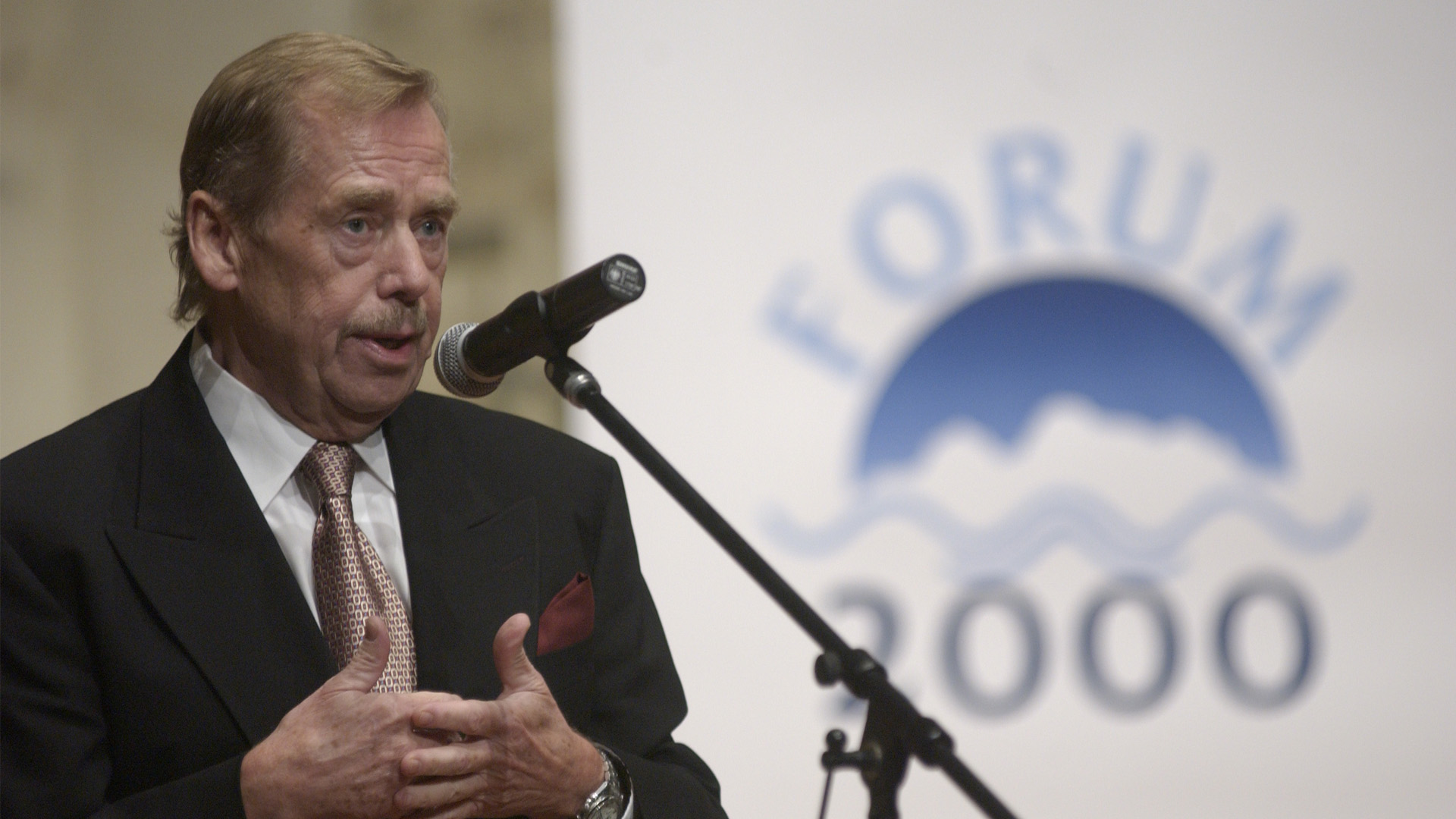
Václav Havel would have celebrated his 90th birthday on October 5. This year also marks a major milestone for Forum 2000, which celebrates 30 years since its founding. Havel established the foundation together with Nobel Peace Prize laureate Elie Wiesel and with the support of Japanese philanthropist Yohei Sasakawa, and his belief in the importance of dialogue, civic responsibility, and individual engagement remains at the heart of Forum 2000 to this day.
The first Forum 2000 Conference took place in Prague in 1997. This gathering brought together prominent figures from around the world to discuss the future of humanity and the challenges it faced. On that occasion, Havel raised a question that remains just as urgent nearly three decades later: “Today the most important thing, in my view, is to study the reasons why humankind does nothing to avert the threats about which it knows so much.” His words reflected his belief that awareness of the problems facing society is not enough – what matters is also the willingness of individuals and society as a whole to take responsibility for them.
The question of individual responsibility and the ability of individuals to influence society is also at the heart of this year’s 30th Forum 2000 Conference, Reimagining the Power of the Powerless, which will take place in Prague on October 11–13, 2026. The opening panel, Václav Havel’s Courage of the Powerless, will return directly to Havel’s essay The Power of the Powerless and its exploration of the relationship between the individual and the system. “Individuals confirm the system, fulfill the system, make the system, are the system,” Havel wrote.
The panel will explore what the “power of the powerless” means today in a world increasingly shaped by power politics. It will examine where the line lies between compliance with the system and personal integrity, and how Havel’s concept of civic responsibility can be applied to defending democracy today. The discussion will also address new challenges, including digital manipulation, societal polarization, and declining public trust in democratic institutions.
Havel’s legacy will also resonate throughout other parts of this year’s program. The 30th conference will feature dozens of discussions on the future of democracy, human rights, civic engagement, and the resilience of democratic societies. It will also focus on a new generation and the ways in which young people are finding their own paths toward civic and democratic engagement.
Thirty years after the first conference, Forum 2000 continues the dialogue that Václav Havel helped initiate in Prague. His ideas are not merely a reminder of the past. They continue to inspire a question that Forum 2000 has explored throughout its existence: What can an individual do when it seems that they have too little power to stand against the forces shaping the world?
